Thursday, March 10, 2011

Maple Leaf tartan officially recognized as national symbol

The Maple Leaf tartan, a national symbol


In 1964, in the run-up to Canada's 1967 centennial celebrations, Toronto-based designer David Weiser produced the Maple Leaf tartan. It quickly gained popularity as "Canada's tartan" and took its place alongside the other provincial and traditional tartans beloved by Canadians from east to west.


Weiser was inspired by Canada's quintessential national symbol, the maple leaf, and the changes through which it progresses in various seasons. Green in summer, turning to yellow and red in fall, and then brown come winter.

Since its conception, the tartan has been adopted by the Second Battalion of the Royal Canadian Regiment Pipes and Drum corps, and National Defence has approved its use by Canadian Forces pipers and drummers who do not have a specific regimental affiliation.

Yet while it has always been a popular traditional tartan, it had never been officially recognized  by Parliament as Canada's tartan. On March 9, 2011, Heritage Minister James Moore announced the formal recognition of the role the Scots and those of Scottish descent have played in Canada's exploration and growth as a nation.

Monday, February 28, 2011

I called it! The King's Speech takes top honour at Oscars 2011

I had heard some buzz about a film concerning King George VI of England called "The King's Speech." It didn't seem to have tremendous advertising support behind it but word was it was a fantastic film starring some of my favourite British actors: Colin Firth, Helena Bonham Carter and Jennifer Ehle.

I loved everything about the film, and was blown away by Firth's portrayal of Prince Albert. In fact, every one of the historic portrayals - from that of his father, King George V, to Bonham Carter's Queen Elizabeth (later, the Queen Mother), to his brother Edward VIII - bore out what we now know to have been the family dynamics and individual personalities involved. And I like Edward even less now that before, if that is possible.

If Oscars are truly awarded based on artistic skill, I believed Firth would win best actor and the film will be chosen as best film. I thought Helena Bonham Carter deserved recognition for her portrayal of the reigning monarch's mom, too, but somehow I didn't think that would happen given the rest of the field for best actress.

The sets and art direction were amazing and true to the period in the smallest detail. It was a joy to watch the story unfold, and the experience was made even more poignant when I learned that the writer had withheld completing the story until after the Queen Mother's death at her request.

King George VI (left) and Colin Firth portraying the king


And at the end, I cried. I was so proud of "him"! Of Colin Firth for his amazing performance, and of Bertie for his strength of character. Contrasting the behaviour of elder brother Edward with that of younger brother Albert, the world should be grateful George VI was at the helm during the Second World War. Born to rule or not, he was clearly the right man for the job. 

Colin Firth will now be, forever in my mind, Mr. Darcy and King George VI.

Sunday, February 13, 2011

When is a tartan, a plaid? A plaid, a tartan?

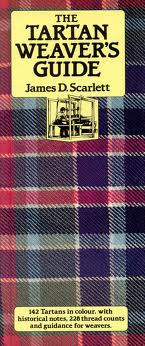
The Tartan Weaver's Guide
Prior to receiving this question I had maintained that a tartan was a design registered with the Court of Lord Lyons in Britain, representative of a Scottish clan, a military regiment, a corporation, even a fashion design (such as Burberry). To me, everything else was just plaid.

It turns out I wasn't wrong, but it wasn't the whole story either.

Historically, a plaid is a garment, and originates in the Gaelic word for blanket. Ancient Scots wore belted and unbelted plaids, or large blankets gathered around the waist or as large shawls. As modern Highland dress, plaid refers to any tailored or untailored garment about the shoulders. Regardless of the pattern or colour, plaid traditionally refers to clothing.

Plaids, the garments, were often of a pattern, including tartan patterns. Tartans are representations of clan membership. The combination of colours, the pattern in which they are woven and thus intersect, and the resulting pattern of colour tones and half-tones make up a tartan. Typically tartans are symmetrical, the pattern repeating in setts or at regular intervals, although some tartans, and in particular old unnamed tartans, can be asymmetrical.

Thefreedictionary.com describes a tartan as "any of numerous textile patterns consisting of stripes of varying widths and colors crossed at right angles against a solid background, each forming a distinctive design worn by the members of a Scottish clan."

While accurate, this definition isn't complete. There are also Irish tartans and tartans designed and produced for military, corporate and national purposes. Irish clans did not typically have clan tartans, unless they emigrated to Scotland and either established a clan there or came under the protection of a Scottish clan.

The Irish tartans available commercially were commissioned by a U.K. weaving company, are named after the Irish counties and not registered with any tartan authority.

In North America, any textile in a pattern of criss-crossing lines of varying colour and width, that is not a tartan, and thus not registered as representative of membership in a Scottish clan, is called a plaid. But this is a North American term, not a historically correct term for either a plaid or a tartan.

"The Eagle" portrays early Scots

Let's start at the ending, so that I can say I liked almost everything about this movie... except the ending.
 
I wasn't dismayed by the fact that there were no CGI or 3-D or other extra-special effects. I am of the generation for whom British novelist Rosemary Sutcliffe's book The Eagle of the Ninth (published 1954) was required reading in elementary school. So, just as it is it is a much-better representation of that story than would have been available before now.
The Eagle of the Ninth is a childrens book, and the first of a fiction series that depicts the Roman occupation of Britain in the second century AD. The movie, The Eagle, is rated PG and intended as family entertainment with just enough blood and gore to amuse 12-year-old boys in these early years of the 21st century. (To wit, the meal of a raw dead rat; one obvious decapitation resulting is a rolling head; several bloody battles and two off-screen throat-slittings.)
For the most part, the film was true to the original work. There were a reasonable number of Celts, Druids, and Picts portrayed battling a beleaguered, smaller number of Roman military and Romans-turned-Caledonians, rather than hordes of any of these races. No gratuitous love story or female characters were added, and in that it was faithful to history as well. There were few if any Roman ladies present in northern England and men posted there generally took local "wives" to bed and fathered mixed-race children who were abandoned when their dads were recalled to Rome.
Pictavia, as the Romans called the land occupied by a tribe they named Picts, is said to have merged with another northern tribe to form the Kingdom of Alba, which we now call Scotland. The Picts never called themselves such; Rome gave names to the people and places they conquered. We don't know what the Picts called themselves but in the movie, they are referred to as the Seal People.
The "seal people" are a reference to an ancient folkloric tale about shape-shifting inhabitants of the Orkney Islands who were said to be able to change their shape from that of a seal to human, so as to mate with human females. These "silkies" or "selkies" were the inspiration for the far-northern inhabitants wearing seal furs and coated in bluish mud that the movie portrays as having devastated the ninth Roman legion.
There were a few token ginger-haired Picts and Caledonians, but if you were looking for a lot of red-haired wives and bairns you would be mistaken, as the red hair for which the Scots and Irish are famous was the result of the Viking blood introduced violently into their cultures some time later.
Most of the action scenes appear to have been shot in Hungary, while the panoramic scenes Esca and Marcus view after they travel past Hadrian's Wall were shot in Scotland. Unfortunately the time of the year portrayed appears to be early spring, as there was still snow on the ground in places and the rain was incessant. So if you are hoping to see green and purple Scottish Highland vistas in the film, you will be disappointed. The film does the Scottish tourism folks no favours.
As was Sutcliffe's intent, screenwriter Jeremy Block's words deliver a message: Rome is bad, freedom is good and Romans are mean, old men who take away the freedom of the poor Britons. At one point, Roman Marcus is reduced to the position of slave, while Esca becomes his supposed master and all manner of behaviour and acts are inflicted upon Marcus with the end result that the young Roman comes to appreciate the plight of Esca and all Roman slaves everywhere.
All in all, I have two major criticisms of this movie.
First, I was expecting British accents for the Roman characters. Maybe I am just conditioned to expect Brit voices when it comes to Romans, having watched and loved all 22 episodes of the BBC television series, Rome. But I just couldn't get past the American and Canadian accents (nod to Donald Sutherland) whenever the "Romans" spoke.
As for the ending... blah. Marcus the Roman and Esca the Briton walk off into the sunset as equals, after Marcus delivers a snipe to a snot-nosed Roman in a toga about his former slave's better understanding of freedom and honour. I pictured Luke Skywalker and Hans Solo. It was lame. And it set up the audience for a sequel that will never be filmed.
Despite its many good qualities, this movie will never make enough at the box office to justify the expense of shooting the next book in Sutcliffe's series. But as for depicting a realistic picture of ancient Scotland, it didn't do badly at all.

There are so many tartans listed for my clan. What is the difference?

Royal Stewart
A clan may have one or more setts and, to confuse things even more, may have variations on colours within a sett.

Generally, there is a BASIC sett, such as Royal Stewart (shown at the left, top). There may be a DRESS Stewart, (below) in which white replaces the red, that is typically work on formal occasions or for evening wear. Dress tartans generally employ more white as they are based on a ladies version of the tartan.

Stewart Dress tartan fabric
Dress Stewart

A HUNTING sett were supposedly developed as a darker alternative that could be worn as "camouflage" while hunting, thus we have the Hunting Stewart (shown to the right, bottom).

Then we have the ANCIENT tartan in which the colours are supposed to replicate the way the tartan would have look when 18th-century or older yarns would have been dyed using vegetable- and mineral-based dyes. The MODERN versions employ more modern yarn-dying techniques that allow for more vibrant colours,

Stewart Hunting tartan fabric
Stewart Hunting

If you're not confused enough, let me tell you about REGIONAL tartans, such as MacLeod of Lewis and MacLeod of Harris. Both are within the MacLeod clan, but have distinctively different tartan setts indicating that there members originated in one region under the control of the MacLeod clan.

What is a sett?
A sett is the unique pattern of colour blocks and lines that make up a distinctive tartan. One "repeat" of the pattern is called the sett. The width of the repeat makes no difference, so long as the pattern within the sett is accurate and consistent. On our listings we indicate the width of the sett, or the measurement from the first colour line of the pattern to the last, where it starts to repeat, in inches. 
If you have other questions, feel free to contact me at vicki@tartanhousecanada.com

What if I can't find a tartan I am "entitled" to wear?

Honestly, there is no "tartan police." In Canada, where 4,709,850 Canadians, or 15% of the population, listed themselves as of Scottish origin in the 2006 census, the claims to entitlement to wear one tartan over the other become irrelevant.

If you're one for exactitude, however, there are a number of tartans anyone can wear - so-called "universal" tartans. Some of the older universal tartans include: Hunting Stewart, Black Watch, Caledonian, and Jacobite. More modern tartans that can be worn universally are Scottish National, Brave Heart Warrior, Flower of Scotland and Pride of Scotland.

Many of these newer tartans include purple, because there were designed with the global Scottish wedding market in mind. Another universal tartan is Celtic Pride, designed by an American kiltmaker who registered the pattern with the intent that anyone of Celtic origin - Scot, Welsh, Irish or Brit - would have a tartan they were "entitled" to wear with pride.


You can see the wide range of tartans available from Tartan House Canada by clicking here.

How Canada came to celebrate Tartan Day - April 6

From a letter written by Mrs. Jean L. MacKarcher Watson, past- president of Federation of Scottish Clans In Nova Scotia:

"I have read different articles on Tartan Day and frankly although many are delightful I wish to clarify once and for all how Tartan Day started.

At a meeting of the Federation of Scottish Clans in Nova Scotia in the courthouse rooms in the town of Antigonish, (pronounced; Anti-go-nish) a discussion arose as to how few heroes we have in this day and age and who should our children look to as a hero or a person who could be held up as someone you would like to pattern yourself after.

Many names of Scots who helped settle this country were mentioned. After much discussion it was felt that many young people did not have much interest in their history or backgrounds. It was felt the Scots who came to Nova Scotia to settle and all of Canada as well showed what hard work, determination and faith in God could do.

We felt we should have a day strictly in remembrance of these people.

Our minutes read as follows: March 9, 1986 Motion by Bill Crowell, President of Clan Cameron and seconded by Jean Watson, President of Clan Farquharson... "that we establish a day known as Scot Day". Following discussion this was amended to read 'Tartan Day'". "This to be a day chosen to promote Scottish Heritage by the most visible means. The wearing of Scottish attire especially in places where the kilt is not ordinarily worn, i.e.; work, play or worship... in honour of our forebearers."

I was asked to find a date that would start the Scottish events for the year. April 6th was chosen. Not because it was the same date as the Declaration of Arbroath but because this date stood for the things we felt important to all.

I was given the job to publicize the date. I wrote to every Legislative Assembly Member across Canada individually and to all the Scottish Societies and Clans I could find asking their support. This was a labour of over ten years work.

In ten years Tartan Day spread from coast to coast thanks to all the various organizations Canada-wide who got behind this worthwhile day.

Following the establishment of the day in Ontario word started to spread across the U.S.A. and we were delighted to have them take up the cause.

Tartan Day is celebrated on April 6th and has been legislatively recognized by all provinces except Newfoundland and Quebec."